
Bootstrap resampling is a powerful statistical technique for robust inference. TidyDensity provides integrated bootstrap functionality with seamless visualization and analysis tools.
What is Bootstrap?
Concept
Bootstrap resampling is a non-parametric method for:
- Estimating sampling distributions
- Calculating confidence intervals
- Assessing parameter uncertainty
- Making inferences without distributional assumptions
Bootstrap in TidyDensity
Main Function: tidy_bootstrap()
Generate bootstrap samples in tidy format:
tidy_bootstrap(
  .x,                    # Your data vector
  .num_sims = 2000,      # Number of bootstrap samples
  .proportion = 0.8,     # Proportion to sample (default = 0.8)
  .distribution_type = "continuous"  # continuous or discrete
)Basic Bootstrap Analysis
Simple Bootstrap Example
# Your data
data <- mtcars$mpg

# Perform bootstrap
bootstrap_data <- tidy_bootstrap(
  .x = data,
  .num_sims = 2000
)

# View structure
head(bootstrap_data)
#> # A tibble: 6 × 2
#>   sim_number bootstrap_samples
#>   <fct>      <list>
#> 1 1          <dbl [25]>
#> 2 2          <dbl [25]>
#> 3 3          <dbl [25]>
#> 4 4          <dbl [25]>
#> 5 5          <dbl [25]>
#> 6 6          <dbl [25]>
Visualizing Bootstrap Distribution
# Density plot of bootstrap distribution Cumulative Mean
bootstrap_stat_plot(bootstrap_data, .value = y, .stat = "cmean")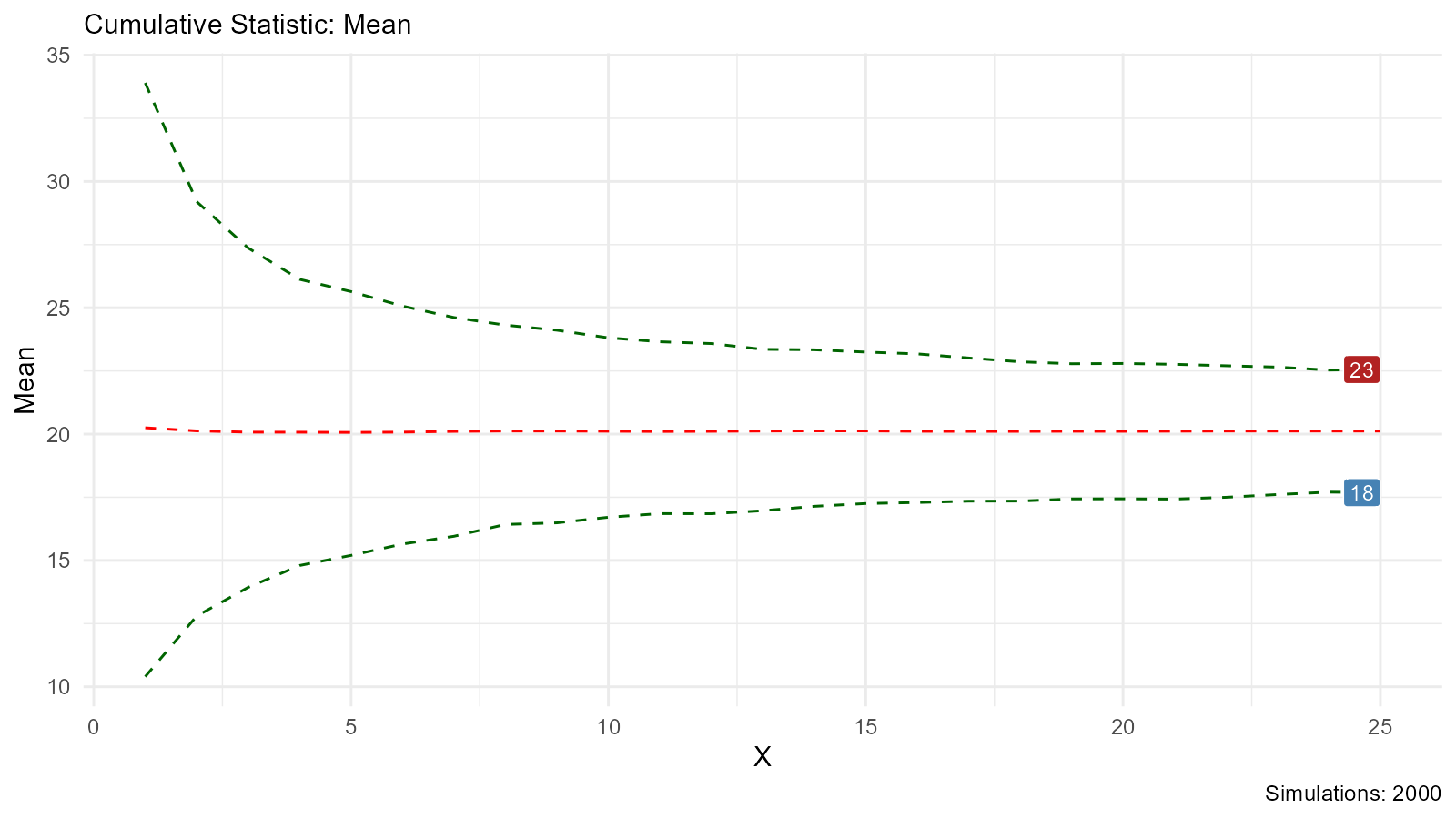
# Cumulative Harmonic Mean
bootstrap_stat_plot(bootstrap_data, .value = y, .stat = "chmean")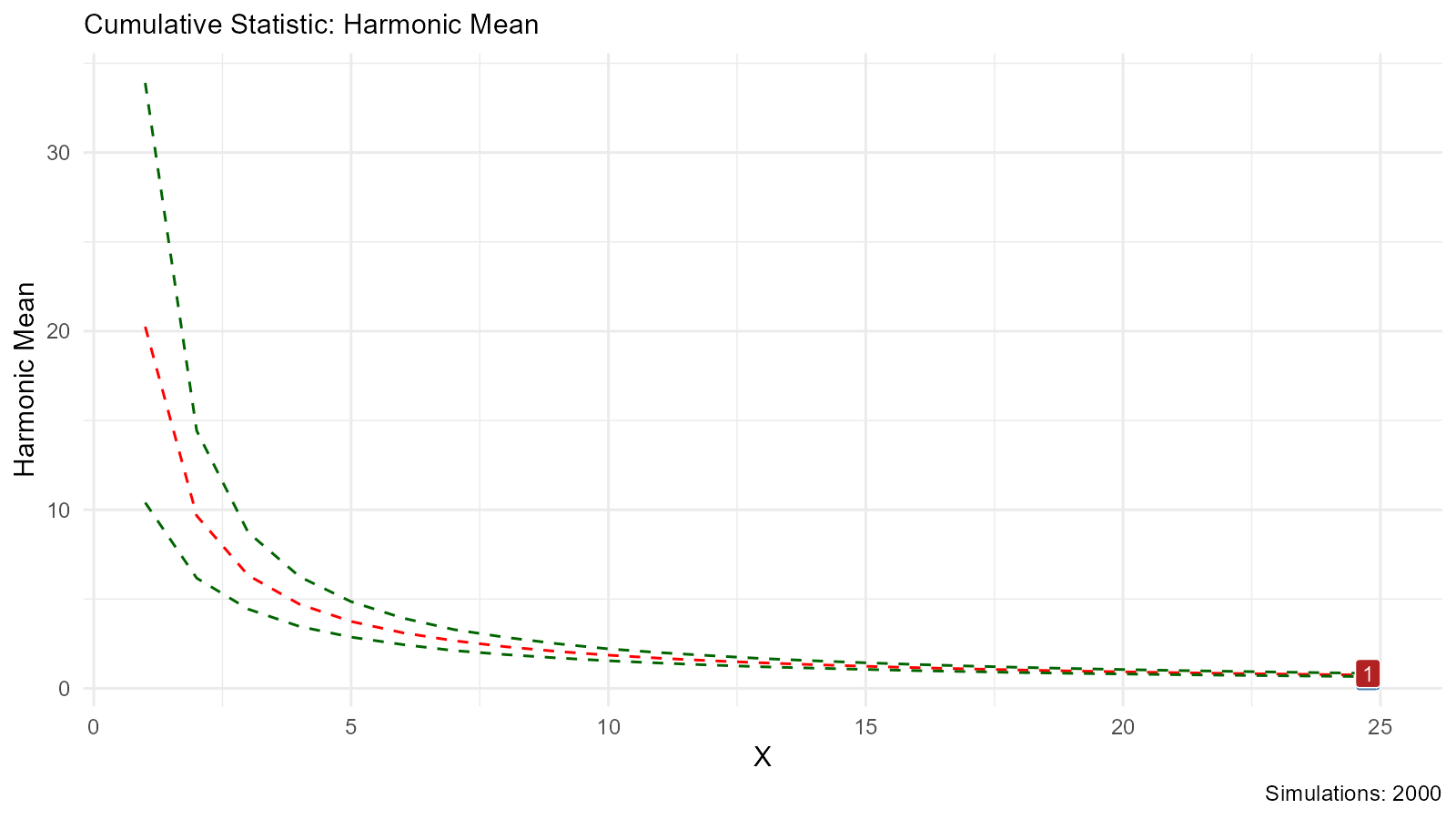
# Show Groups
bootstrap_stat_plot(bootstrap_data, .value = y, .stat = "cmean",
                    .show_groups = TRUE)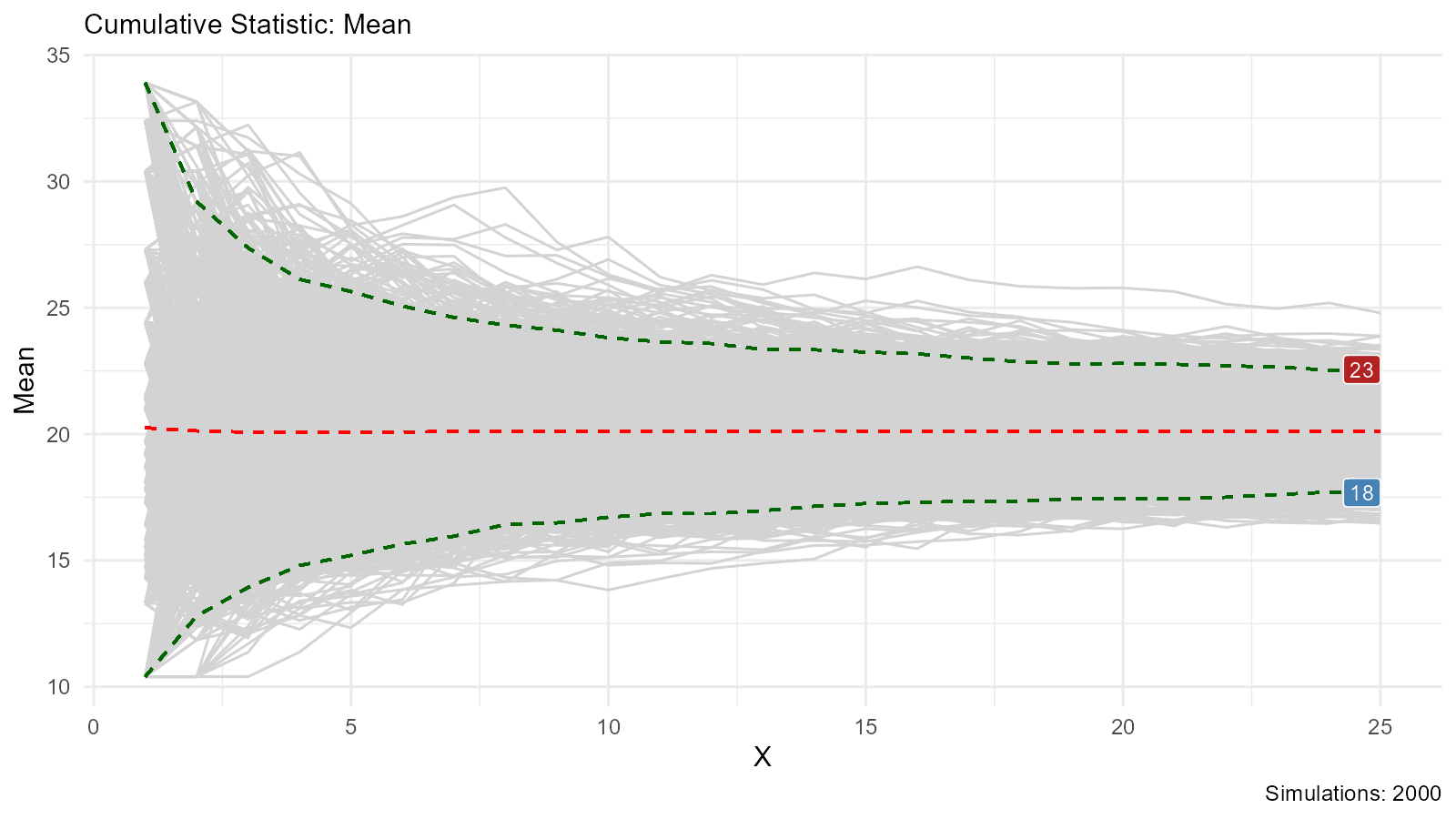
Quick Statistics
# Get basic statistics
summary(bootstrap_data |> bootstrap_unnest_tbl() |> pull(y))
#>    Min. 1st Qu.  Median    Mean 3rd Qu.    Max.
#>   10.40   15.50   19.20   20.12   22.80   33.90

# Count simulations
length(unique(bootstrap_data$sim_number))
#> [1] 2000
Bootstrap Statistics
Unnesting Bootstrap Data
Use bootstrap_unnest_tbl() to work with bootstrap
samples:
# Unnest the bootstrap data
unnested <- bootstrap_data |>
  bootstrap_unnest_tbl()

# Now you can calculate statistics
head(unnested)
#> # A tibble: 6 × 2
#>   sim_number     y
#>   <fct>      <dbl>
#> 1 1           15
#> 2 1           10.4
#> 3 1           30.4
#> 4 1           15.2
#> 5 1           22.8
#> 6 1           19.2
Calculating Bootstrap Statistics
# Calculate statistics for each bootstrap sample
bootstrap_stats <- bootstrap_data |>
  bootstrap_unnest_tbl() |>
  group_by(sim_number) |>
  summarise(
    mean = mean(y),
    median = median(y),
    sd = sd(y),
    q25 = quantile(y, 0.25),
    q75 = quantile(y, 0.75)
  )

# View distribution of means
summary(bootstrap_stats$mean)
#>    Min. 1st Qu.  Median    Mean 3rd Qu.    Max.
#>   16.47   19.34   20.09   20.12   20.91   24.79
hist(bootstrap_stats$mean, main = "Bootstrap Distribution of Mean",
     xlab = "Mean", col = "lightblue")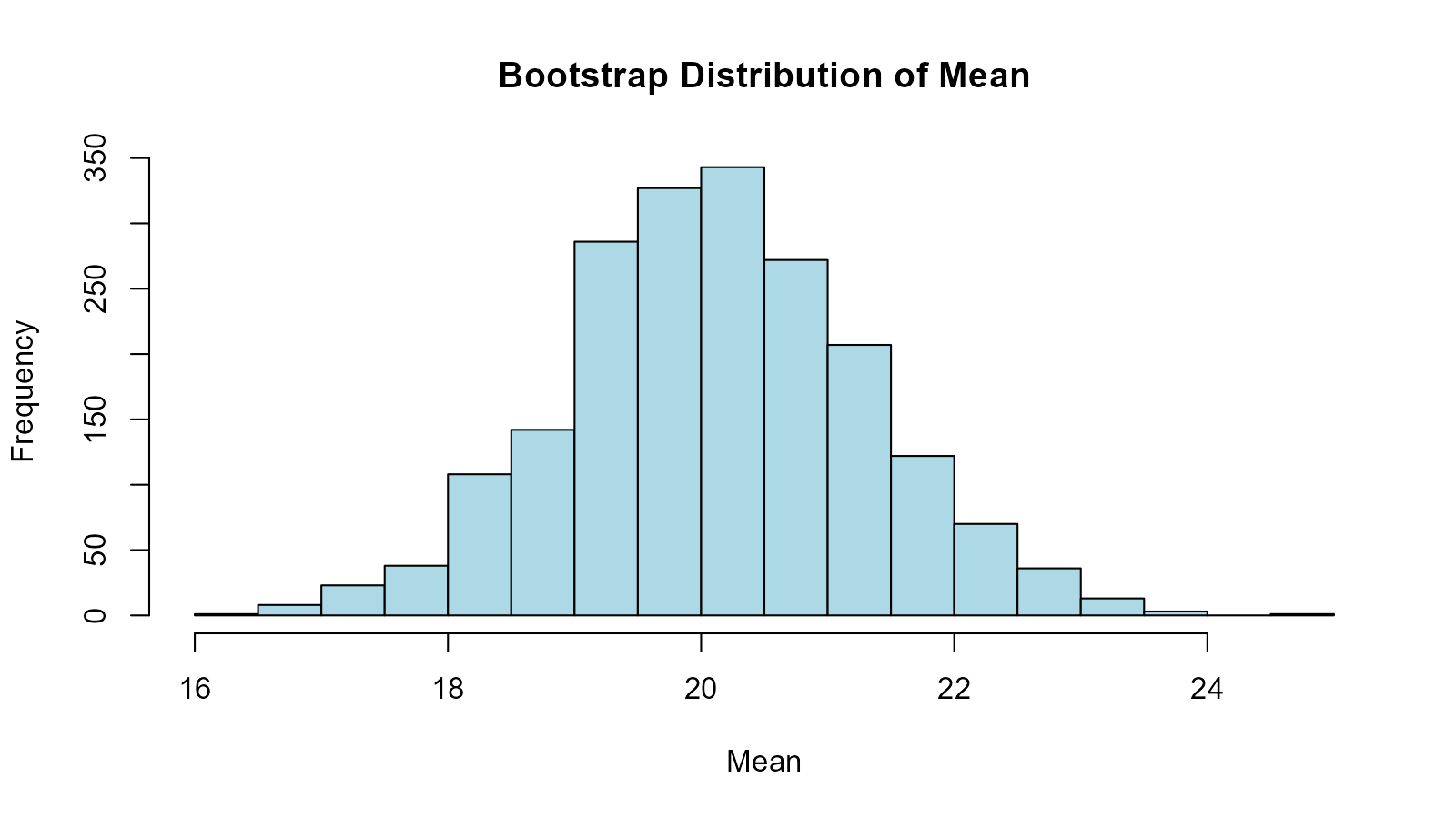
Overall Bootstrap Statistics
# Calculate overall statistics from all bootstrap samples
overall_stats <- bootstrap_data |>
  bootstrap_unnest_tbl() |>
  summarise(
    mean_est = mean(y),
    sd_est = sd(y),
    median_est = median(y)
  )

overall_stats
#> # A tibble: 1 × 3
#>   mean_est sd_est median_est
#>      <dbl>  <dbl>      <dbl>
#> 1     20.1   5.94       19.2
Confidence Intervals
Bootstrap Percentile Method
Most common and intuitive method:
# Calculate 95% confidence intervals
ci_level <- 0.95
alpha <- 1 - ci_level

bootstrap_ci <- bootstrap_data |>
  bootstrap_unnest_tbl() |>
  summarise(
    lower_ci = quantile(y, alpha/2),
    upper_ci = quantile(y, 1 - alpha/2),
    point_estimate = mean(y)
  )

bootstrap_ci
#> # A tibble: 1 × 3
#>   lower_ci upper_ci point_estimate
#>      <dbl>    <dbl>          <dbl>
#> 1     10.4     33.9           20.1
Confidence Intervals for Multiple Statistics
# Calculate CI for mean, median, and sd
ci_stats <- bootstrap_data |>
  bootstrap_unnest_tbl() |>
  group_by(sim_number) |>
  summarise(
    mean = mean(y),
    median = median(y),
    sd = sd(y)
  ) |>
  summarise(
    across(
      c(mean, median, sd),
      list(
        lower = ~ unname(quantile(.x, 0.025)),
        estimate = ~ unname(mean(.x)),
        upper = ~ unname(quantile(.x, 0.975))
      )
    )
  )

glimpse(ci_stats)
#> Rows: 1
#> Columns: 9
#> $ mean_lower      <dbl> 17.6837
#> $ mean_estimate   <dbl> 20.11925
#> $ mean_upper      <dbl> 22.5564
#> $ median_lower    <dbl> 16.4
#> $ median_estimate <dbl> 19.28125
#> $ median_upper    <dbl> 21.4025
#> $ sd_lower        <dbl> 4.104046
#> $ sd_estimate     <dbl> 5.879158
#> $ sd_upper        <dbl> 7.384673
Visualizing Confidence Intervals
# Create visualization
unnested |>
  ggplot(aes(x = y)) +
  geom_density(fill = "lightblue", alpha = 0.5) +
  geom_vline(xintercept = unname(quantile(unnested$y, 0.025)),
             linetype = "dashed", color = "red") +
  geom_vline(xintercept = unname(quantile(unnested$y, 0.975)),
             linetype = "dashed", color = "red") +
  geom_vline(xintercept = mean(unnested$y),
             linetype = "solid", color = "darkblue", linewidth = 1) +
  labs(
    title = "Bootstrap Distribution with 95% CI",
    x = "Bootstrap Statistic",
    y = "Density"
  ) +
  theme_minimal()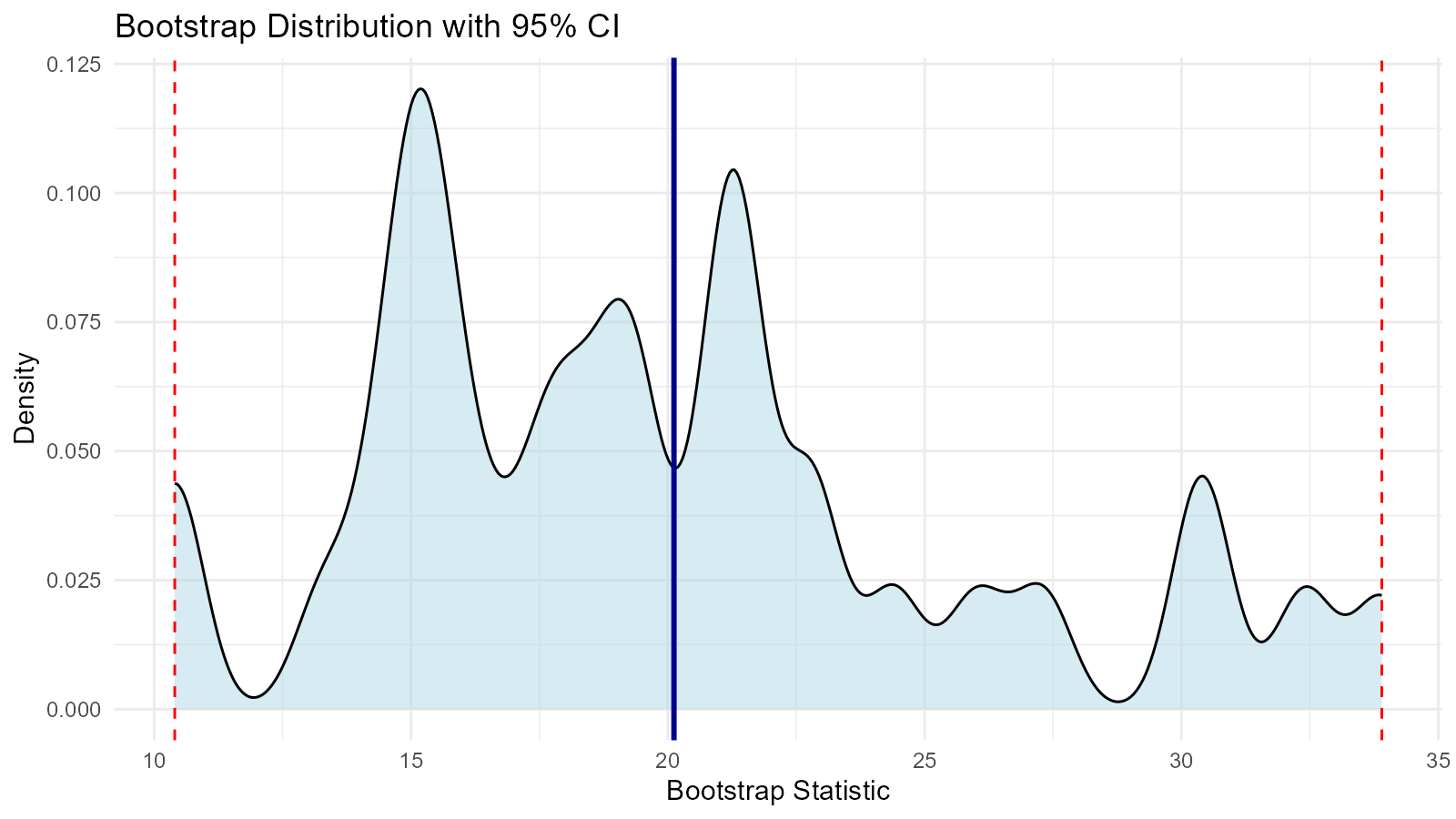
Bootstrap Augmentation Functions
Augment Density
Add density calculations to bootstrap data:
# Augment with density information
augmented_density <- bootstrap_data |>
  bootstrap_density_augment()

head(augmented_density)
#> # A tibble: 6 × 5
#>   sim_number     x     y    dx        dy
#>   <fct>      <int> <dbl> <dbl>     <dbl>
#> 1 1              1  15    1.30 0.0000593
#> 2 1              2  10.4  3.04 0.000286
#> 3 1              3  30.4  4.78 0.00102
#> 4 1              4  15.2  6.51 0.00279
#> 5 1              5  22.8  8.25 0.00624
#> 6 1              6  19.2  9.99 0.0124
Augment Probability
Add cumulative probability:
# Augment with probability information
augmented_prob <- bootstrap_data |>
  bootstrap_unnest_tbl() |>
  bootstrap_p_augment(y)

head(augmented_prob)
#> # A tibble: 6 × 3
#>   sim_number     y      p
#>   <fct>      <dbl>  <dbl>
#> 1 1           15   0.186
#> 2 1           10.4 0.0618
#> 3 1           30.4 0.937
#> 4 1           15.2 0.249
#> 5 1           22.8 0.779
#> 6 1           19.2 0.530
Augment Quantile
Add quantile information:
# Augment with quantile information
augmented_quantile <- bootstrap_data |>
  bootstrap_unnest_tbl() |>
  bootstrap_q_augment(y)

head(augmented_quantile)
#> # A tibble: 6 × 3
#>   sim_number     y     q
#>   <fct>      <dbl> <dbl>
#> 1 1           15    10.4
#> 2 1           10.4  10.4
#> 3 1           30.4  10.4
#> 4 1           15.2  10.4
#> 5 1           22.8  10.4
#> 6 1           19.2  10.4
Advanced Bootstrap Techniques
Bootstrap for Difference of Means
# Two groups
group1 <- mtcars$mpg[mtcars$am == 0]
group2 <- mtcars$mpg[mtcars$am == 1]

# Bootstrap function for difference
bootstrap_diff <- function(n_sims = 2000) {
  diffs <- numeric(n_sims)

  for (i in 1:n_sims) {
    boot_g1 <- sample(group1, length(group1), replace = TRUE)
    boot_g2 <- sample(group2, length(group2), replace = TRUE)
    diffs[i] <- mean(boot_g2) - mean(boot_g1)
  }

  return(diffs)
}

# Run bootstrap
diff_dist <- bootstrap_diff(2000)

# Calculate CI
quantile(diff_dist, c(0.025, 0.975))
#>      2.5%     97.5%
#>  3.827439 10.924939

# Visualize
hist(diff_dist, main = "Bootstrap Distribution of Difference in Means",
     xlab = "Difference in Means", breaks = 50, col = "lightgreen")
abline(v = quantile(diff_dist, c(0.025, 0.975)),
       col = "red", lty = 2, lwd = 2)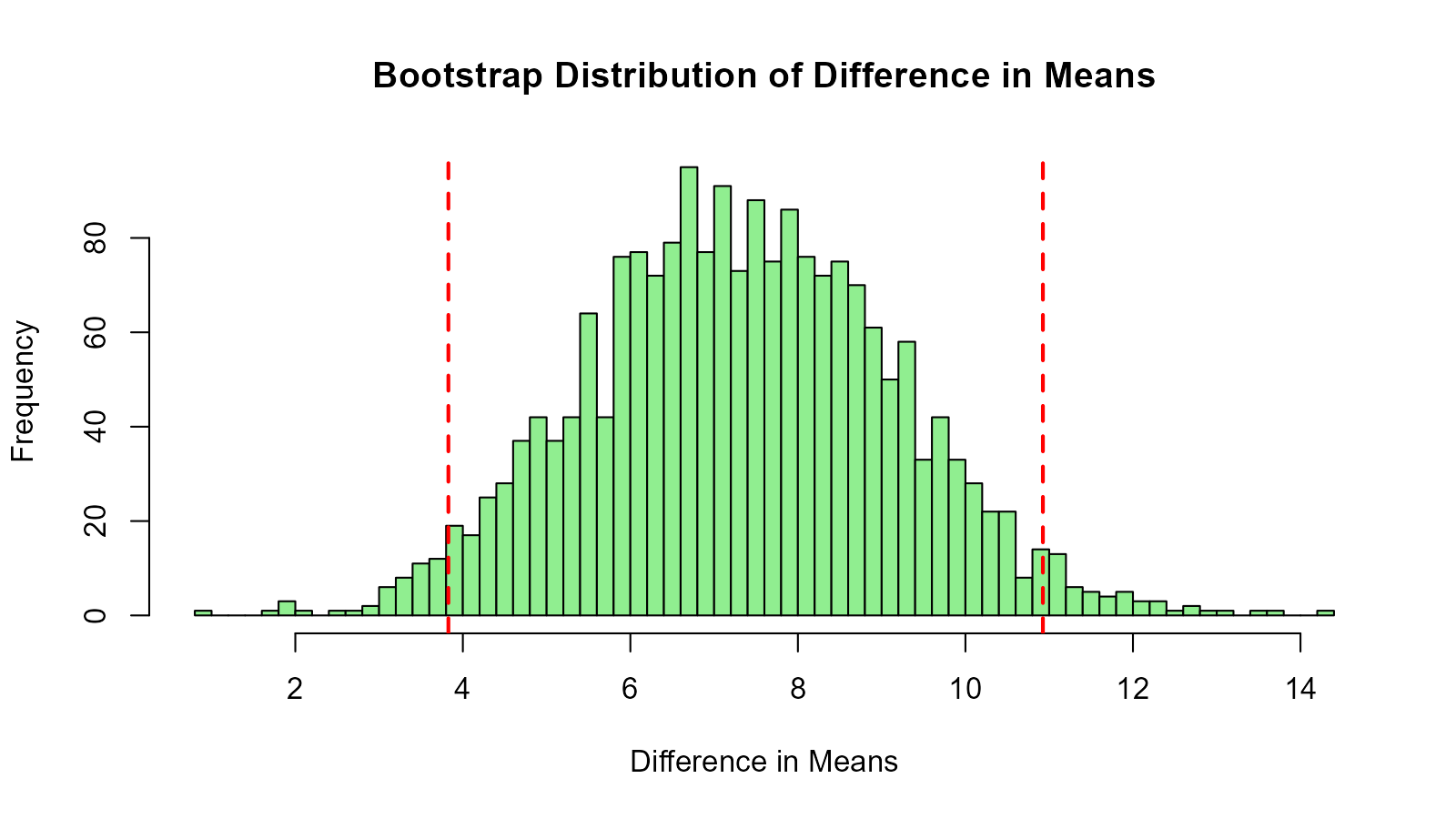
Bootstrap for Correlation
# Original correlation
cor_original <- cor(mtcars$mpg, mtcars$wt)

# Bootstrap correlations
boot_cor <- function(x, y, n_sims = 2000) {
  cors <- numeric(n_sims)
  n <- length(x)

  for (i in 1:n_sims) {
    indices <- sample(n, replace = TRUE)
    cors[i] <- cor(x[indices], y[indices])
  }

  return(cors)
}

# Run bootstrap
cor_dist <- boot_cor(mtcars$mpg, mtcars$wt, 2000)

# CI for correlation
cor_ci <- quantile(cor_dist, c(0.025, 0.975))
cat("95% CI for correlation:", cor_ci, "\n")
#> 95% CI for correlation: -0.9276411 -0.7921946

# Visualize
hist(cor_dist, main = "Bootstrap Distribution of Correlation",
     xlab = "Correlation Coefficient", breaks = 50, col = "lightyellow")
abline(v = cor_ci, col = "red", lty = 2, lwd = 2)
abline(v = cor_original, col = "blue", lwd = 2)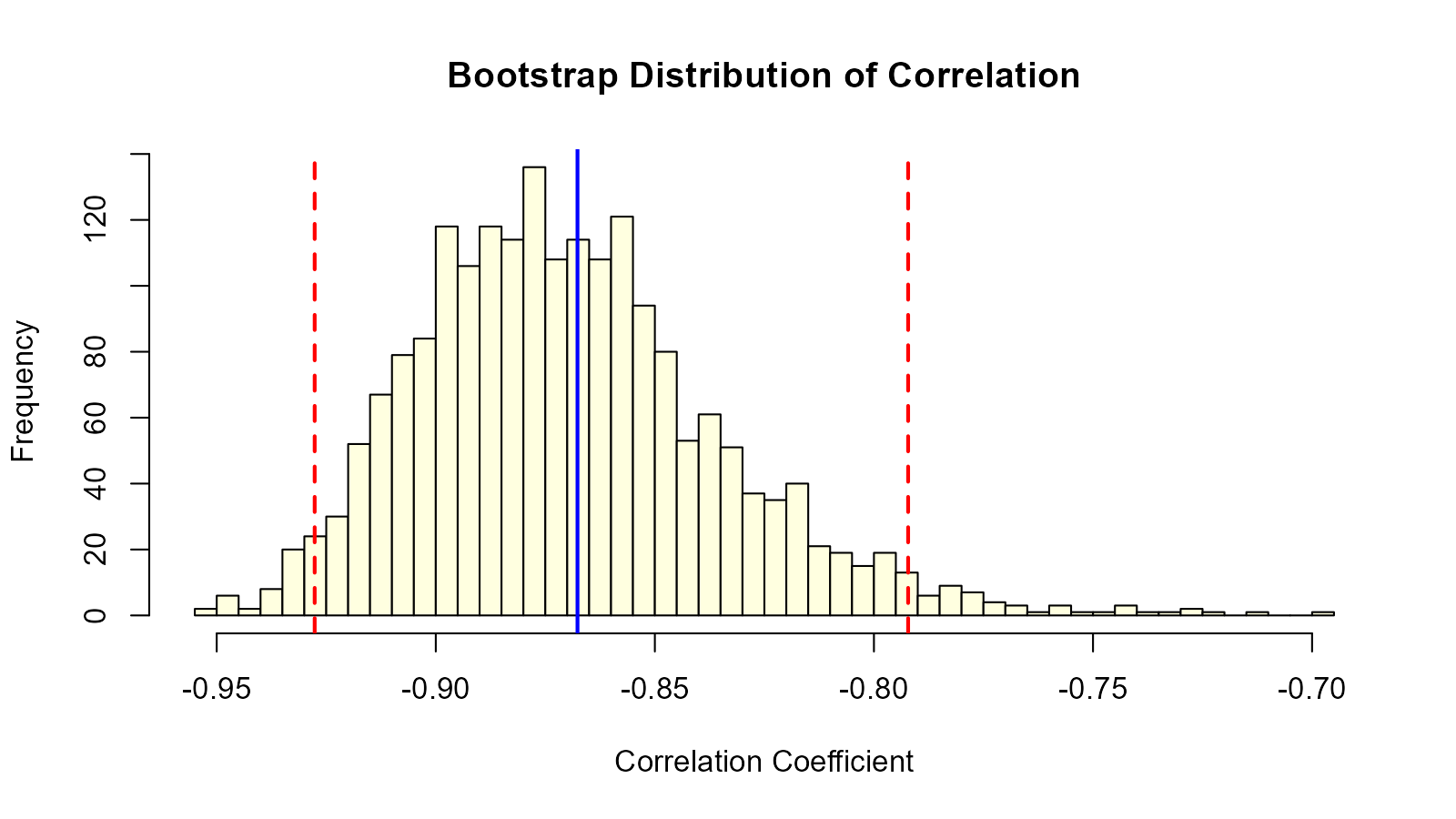
Visualization
Multiple Visualizations
# Generate bootstrap data
boot_data <- tidy_bootstrap(mtcars$mpg, .num_sims = 2000) |>
  bootstrap_unnest_tbl()

# Create multiple plots
p1 <- ggplot(aes(x = y), data = boot_data) +
  geom_density(fill = "lightgreen", alpha = 0.5) +
  labs(title = "Density Plot", x = "Value", y = "Density") +
  theme_minimal()

p2 <- ggplot(aes(x = y), data = boot_data) +
  stat_ecdf(aes(x = y), geom = "step", color = "blue") +
  labs(title = "Probability Plot", x = "Value", y = "Cumulative Probability") +
  theme_minimal()

p3 <- ggplot(aes(x = seq_along(y), y = sort(y)), data = boot_data) +
  geom_point(color = "purple", alpha = 0.1) +
  labs(title = "Sorted Values", x = "Index", y = "Value") +
  theme_minimal()

p4 <- ggplot(aes(sample = y), data = boot_data) +
  stat_qq(color = "orange", alpha = 0.1) +
  stat_qq_line(color = "red") +
  labs(title = "QQ Plot", x = "Theoretical Quantiles", y = "Sample Quantiles") +
  theme_minimal()

# Combine
(p1 | p2) / (p3 | p4)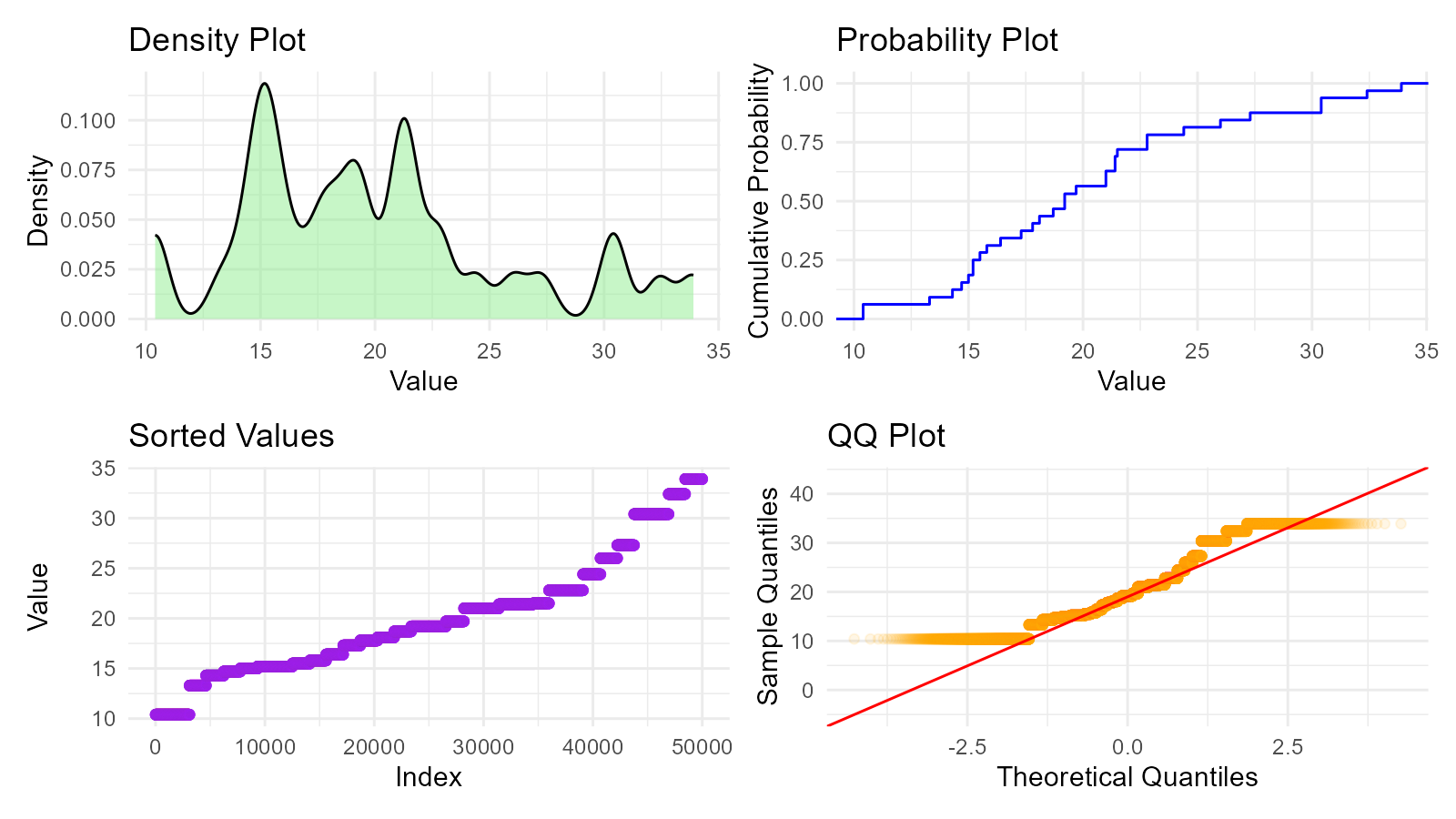
Custom Visualization with CI
# Calculate statistics
ci <- quantile(boot_data$y, c(0.025, 0.5, 0.975))

# Create plot
ggplot(data.frame(y = boot_data$y), aes(x = y)) +
  geom_density(fill = "skyblue", alpha = 0.5) +
  geom_vline(xintercept = ci[1], linetype = "dashed", color = "red") +
  geom_vline(xintercept = ci[2], linetype = "solid", color = "darkblue",
             linewidth = 1.5) +
  geom_vline(xintercept = ci[3], linetype = "dashed", color = "red") +
  annotate("text", x = ci[1], y = 0, label = "2.5%", vjust = -1) +
  annotate("text", x = ci[2], y = 0, label = "Median", vjust = -1) +
  annotate("text", x = ci[3], y = 0, label = "97.5%", vjust = -1) +
  labs(
    title = "Bootstrap Distribution with Confidence Interval",
    x = "Statistic Value",
    y = "Density"
  ) +
  theme_minimal()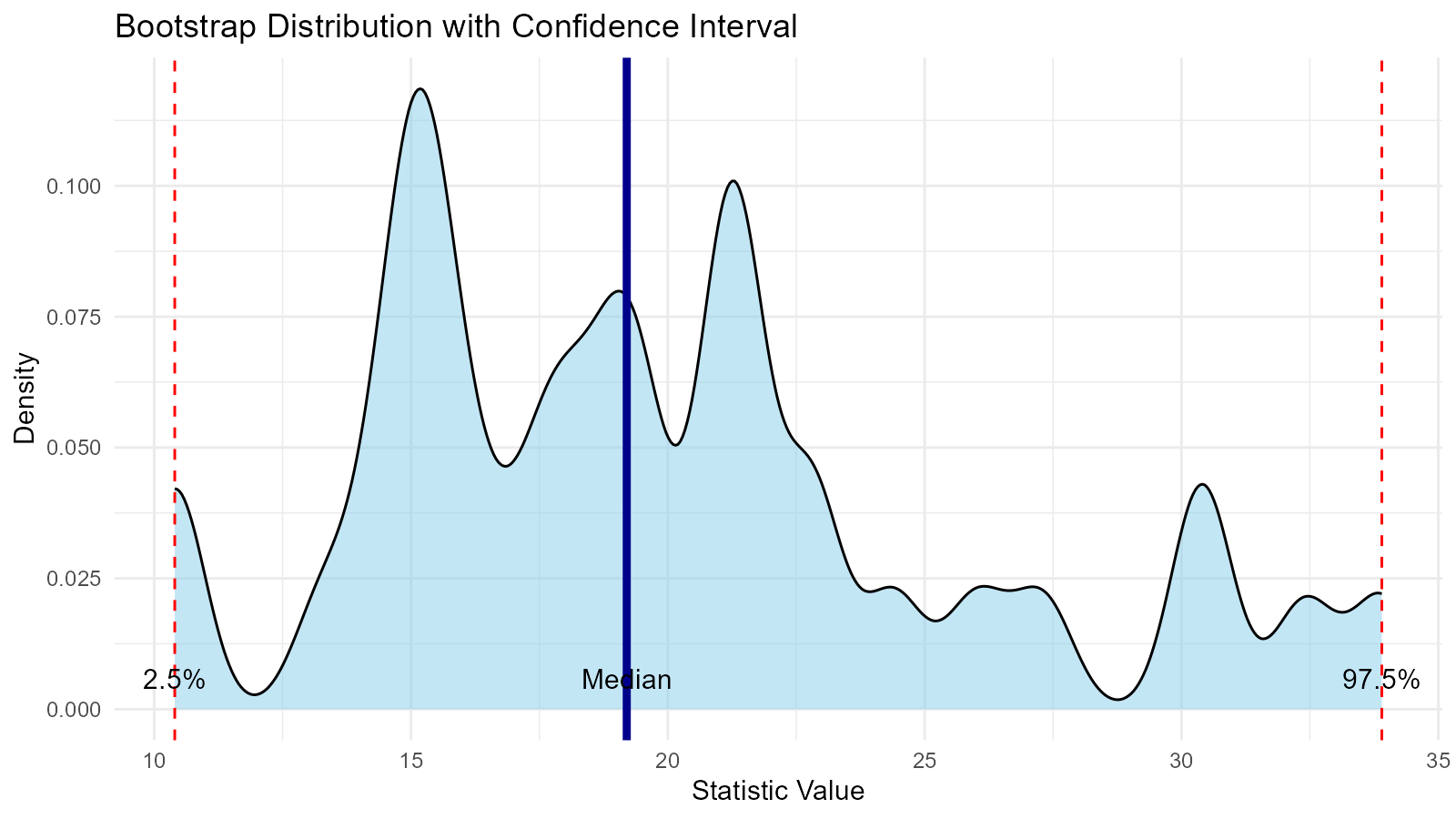
Best Practices
1. Choose Appropriate Number of Simulations
General guidelines:
- Exploratory: 1000 simulations
- Standard analysis: 2000-5000 simulations
- Publication/Critical: 10000+ simulations
2. Verify Bootstrap Convergence
Check stability with different numbers of simulations:
# Check stability with different numbers of simulations
n_sims_vec <- c(500, 1000, 2000)
convergence <- data.frame(
  n_sims = n_sims_vec,
  mean_est = NA,
  ci_lower = NA,
  ci_upper = NA
)

for (i in seq_along(n_sims_vec)) {
  boot <- tidy_bootstrap(data, .num_sims = n_sims_vec[i])
  stats <- boot |>
    bootstrap_unnest_tbl() |>
    summarise(
      mean = mean(y),
      lower = quantile(y, 0.025),
      upper = quantile(y, 0.975)
    )

  convergence[i, 2:4] <- as.numeric(stats)
}

convergence
#>   n_sims mean_est ci_lower ci_upper
#> 1    500 20.11131     10.4     33.9
#> 2   1000 20.06232     10.4     33.9
#> 3   2000 20.07139     10.4     33.9